
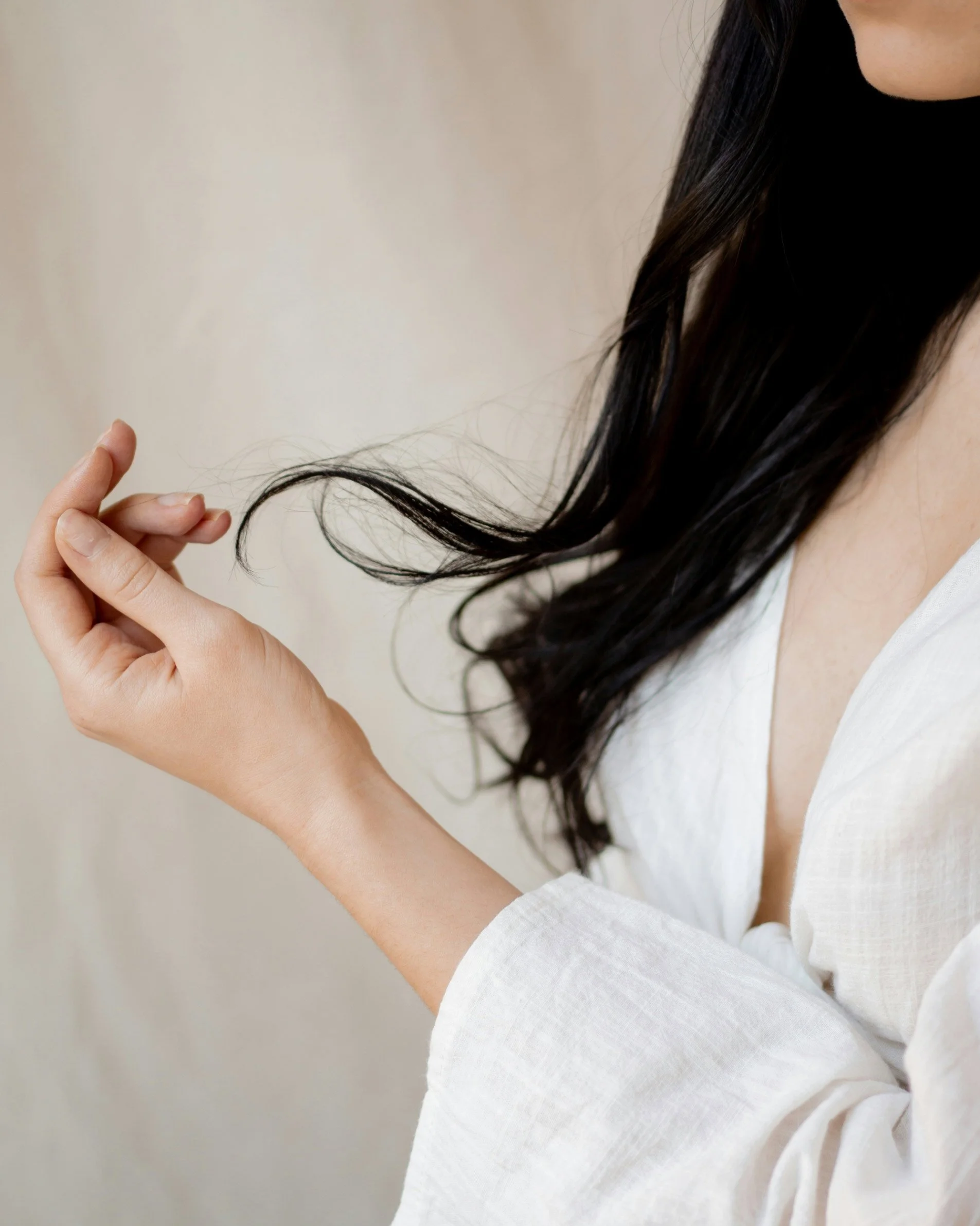
You're finding hair everywhere. On your pillow when you wake up. In the drain after every shower. Wrapped around your baby's fingers. Clumps come out when you brush, and you've started counting how much is in the brush because you need to know if it's getting worse. It is.
Your ponytail is half the thickness it was during pregnancy. You can see your scalp at your temples. You pull your hair back and the thin spots are visible in a way they weren't a month ago. You've started wearing it up every day because wearing it down makes it obvious.
You knew this could happen. Someone mentioned it in passing, or you read about it somewhere between the breastfeeding articles and the sleep training posts. But knowing it could happen and watching it happen to your body are different things entirely.
Your hair is falling out for a reason your body understands even if the mirror is hard to look at right now.
Why Postpartum Hair Loss Happens
During pregnancy, elevated estrogen extends the growth phase of your hair cycle. Hair that would normally shed stays put. Your hair feels thicker, fuller, and healthier than it has in years. This is one of the few physical changes of pregnancy that most women enjoy.
After delivery, estrogen drops rapidly. The hair that was held in its growth phase for months enters the shedding phase all at once. Research published in the Journal of Clinical and Diagnostic Research found that postpartum telogen effluvium, the medical term for this type of shedding, affects up to 50 percent of women and typically begins two to four months after delivery, peaking around month four to six.
This is a normal physiological process. Your body is releasing hair it would have shed gradually over nine months. It comes out in volume because it's all releasing at once.
For many women, the shedding slows by month six to nine postpartum and hair begins to regrow. For others, the shedding persists, regrowth is slow, or the hair that grows back feels different in texture and density. When recovery stalls, something underneath the hormonal shift is usually contributing.
When Postpartum Hair Loss Signals Something More
Normal postpartum shedding is temporary. When hair loss persists beyond nine to twelve months, worsens after initially improving, or is accompanied by other symptoms, something else may be driving it.
Iron deficiency. This is one of the most common and most overlooked contributors to persistent postpartum hair loss. Pregnancy and delivery deplete iron stores. Breastfeeding continues the demand. Research published in the Journal of the American Academy of Dermatology found that ferritin levels below 30 ng/mL are associated with increased hair shedding, and that many women need levels above 50 to support healthy hair growth. Standard bloodwork may report your iron as "normal" when your ferritin is 20. Normal for survival and adequate for hair growth are different thresholds. For more on how depletion affects your body, see our article on postpartum depletion.
Thyroid dysfunction. Postpartum thyroiditis affects up to 10 percent of women and can cause hair loss, fatigue, weight changes, mood shifts, and cycle irregularity. If your hair loss is accompanied by exhaustion that sleep doesn't fix, constipation, or feeling unusually cold, thyroid testing is worthwhile. Request TSH, free T3, free T4, and thyroid antibodies. For more on how thyroid dysfunction affects your health, see our article on how thyroid affects fertility.
Ongoing hormonal imbalance. If your cycle hasn't returned or is irregular, your hormonal environment may still be unstable. Low estrogen, elevated androgens, or insufficient progesterone can all affect hair growth and retention.
Chronic stress and nervous system activation. Cortisol affects the hair growth cycle. Sustained stress can push hair follicles into the shedding phase and delay regrowth. The postpartum period concentrates stressors, including sleep deprivation, the demands of infant care, and the emotional adjustment of new parenthood, in a body that's already depleted.
What Gets Missed
The standard response to postpartum hair loss is reassurance. It's normal. It will stop. It will grow back. For most women, this is true. For the women where the shedding persists or regrowth is slow, reassurance without investigation leaves them waiting for improvement that isn't coming.
Biotin is the most commonly recommended supplement. Research published in Dermatologic Therapy found that biotin supplementation helps hair growth when a true biotin deficiency is present, but most women are not biotin deficient. Taking biotin when the issue is iron, thyroid, or hormonal imbalance doesn't address the driver.
Prenatal vitamins provide baseline nutrition. They're worth continuing postpartum. They're also formulated for pregnancy support, and they may not contain therapeutic levels of the nutrients most relevant to hair recovery, particularly iron, zinc, and vitamin D.
What's consistently missing is an assessment of why the shedding is persisting. Iron levels, thyroid function, hormonal status, nutritional adequacy, and nervous system state all influence whether your hair recovers on its own or needs targeted support.
What Actually Helps
Acupuncture. Research published in the American Journal of Clinical Dermatology found that acupuncture improves scalp blood flow and can support the hair growth cycle by regulating the hormonal and inflammatory factors that influence follicle health. Acupuncture also calms the nervous system, supports digestion and nutrient absorption, and addresses the overall depletion pattern that slows postpartum recovery. We tailor treatment to your specific pattern and where you are in your postpartum recovery. For more on how we support the postpartum period, see our article on postpartum recovery.
Iron repletion. If your ferritin is below 50, supplementation can make a significant difference. Iron bisglycinate is generally well-tolerated and well-absorbed. Pair it with vitamin C for absorption. Iron-rich foods, including red meat, dark leafy greens, beets, and blackstrap molasses, support ongoing repletion. Recheck your ferritin after three months of supplementation.
Chinese herbs. Postpartum herbal formulas address the specific pattern driving the hair loss. Blood deficiency formulas build what was lost during pregnancy, delivery, and breastfeeding. Kidney yin formulas support the root energy that governs hair growth in Chinese medicine. The formula adjusts as your pattern shifts.
Nutrition. Adequate protein at every meal supports hair structure. Healthy fats support hormonal health. Zinc, vitamin D, omega-3s, and B vitamins all play roles in the hair growth cycle. Many postpartum women are undereating without realizing it because the demands of newborn care leave no time for meals. Eating enough, consistently, is one of the most fundamental interventions.
Stress regulation. Sleep, help, and anything that reduces the total demand on your nervous system. Acupuncture, breathwork, and the simple act of having one hour a week dedicated to your own recovery all matter. Your body prioritizes survival functions when it's depleted. Hair growth is one of the last things to recover because it's the least essential. Giving your body more margin accelerates everything.
What This Looks Like in Practice
A woman came to us at 43, seven months postpartum with her second child. Her hair had started shedding at month three and hadn't slowed. She was finding clumps in the shower every morning. She'd developed a thin patch near her left temple that was visible when she pulled her hair back.
She hadn't worn her hair down since month four. She wore it in a tight bun every day to hide how thin it had gotten. She told us she felt vain for caring about her hair when she had a healthy baby. We told her it was okay to care about both.
Her OB had told her the shedding was normal and would stop. Her bloodwork had come back fine. She'd been taking biotin, collagen, and a prenatal vitamin for three months with no change. On paper, everything looked normal.
What we saw was a woman who hadn't slept more than three consecutive hours since her baby was born. She was breastfeeding around the clock, caring for a toddler during the day, and running on caffeine and adrenaline. Her nervous system was in survival mode. Her body was directing every available resource toward keeping her functional, and hair growth was at the bottom of the priority list.
We started with weekly acupuncture focused on calming her nervous system and rebuilding her energy. We prescribed Chinese herbs for blood building and kidney yin support. We talked about nutrition, about eating enough protein and iron-rich foods at every meal, and about finding any way to get one longer stretch of sleep at night.
Around month two, the shedding got worse for a short period. She found the thin patch near her temple had widened. She wanted to stop treatment. We explained that the hair cycle has a lag. The follicles that were going to shed had already been triggered months ago. The changes happening now would show up in her hair two to three months from now.
By month four, the shedding had slowed significantly. She was sleeping a four-hour stretch most nights. Her energy had shifted. She told us she felt less like she was surviving and more like she was living. By month six, she had visible regrowth at her temples, short new hairs standing up along her hairline. She told us she'd worn her hair down for the first time in eight months. She said it wasn't back to what it had been, and she didn't care. It was growing.
Read stories from women we've worked with →
Frequently Asked Questions
How long does postpartum hair loss last? Postpartum shedding typically begins two to four months after delivery, peaks around month four to six, and resolves by nine to twelve months for most women. If shedding persists beyond twelve months, worsens after initially improving, or is accompanied by fatigue, cold sensitivity, or cycle irregularity, evaluation for iron deficiency, thyroid dysfunction, or ongoing hormonal imbalance is worthwhile.
Can you prevent postpartum hair loss? The hormonal shift that triggers postpartum shedding is a normal physiological process and can't be entirely prevented. Supporting your body through the postpartum period with adequate nutrition, iron repletion, rest, and stress reduction can minimize the severity and duration. Women who address depletion early tend to recover faster and experience less prolonged shedding.
Does breastfeeding cause hair loss? Breastfeeding itself doesn't cause hair loss, but it extends the hormonal environment that can contribute to it. Breastfeeding keeps estrogen and progesterone lower, maintains higher prolactin, and increases nutritional demands, particularly iron and protein. Supporting your body nutritionally while breastfeeding helps minimize the impact on your hair.
Your Next Step
Postpartum hair loss can feel isolating, especially when you're told it's normal and to wait it out. If the shedding isn't stopping, or if you want to support your body's recovery so your hair comes back stronger, we can help.
Learn more about our Pregnancy & Postpartum stage or contact us at 212.432.1110 or info@fafwellness.com.
Keep Reading:
• Postpartum Depletion: Why You're So Exhausted
• Postpartum Recovery: Supporting Your Body After Birth
• Getting Your Period Back After Baby: What to Expect and What Helps